You do not need a $295 monthly subscription to find out which buyer questions omit your product and what to work on next. Among AthenaHQ alternatives, we recommend Clare Videre for SaaS teams that want a smaller monthly commitment and specific website and source opportunities. Peec AI is worth comparing for bundled daily tracking; OtterlyAI offers a smaller starting plan.
AthenaHQ's Starter plan includes more than monitoring, so the right replacement depends on what you actually use. Below, we separate introductory credits from recurring allowances, calculate a realistic workload, and compare seven tools by the work they help you do.
AthenaHQ alternatives at a glance
| Alternative | Why consider it? | Published plan |
|---|---|---|
| Clare Videre | Focused SaaS monitoring with evidence behind the next task | $99.95/month in usage credits; captured ChatGPT answers cost $0.10 each |
| Peec AI | Daily tracking and a shared action list for your team | Starter: €85/month, 50 prompts, three models |
| OtterlyAI | Start with 15 buyer questions at a lower monthly price | Lite: €29/month, four engines; API and MCP require Standard |
| Rankscale | Choose run frequency and investigate source-level detail | Pro: €99/month, 1,200 execution credits; a smaller annual Essentials plan is available |
| Scrunch | Make page audits central to your optimization work | Core: $250/month, 125 prompts, 5,000 monthly responses |
| Profound | Evaluate a larger enterprise monitoring and content program | Seven-day brand trial; custom Enterprise pricing |
| Evertune | Start with monitoring or move into message testing | Starter: $60/month; Content Studio requires $800/month Pro, billed annually |
Prices use the currencies displayed in the linked plans and screenshots. A prompt slot, an answer, and a credit are different units; compare the workload each plan covers.
What does AthenaHQ's $295 plan actually include?
AthenaHQ Starter costs $295/month and includes 3,600 monthly credits, with one credit used per AI response. It supports unlimited topics and prompt creation across 11 models. That model coverage gives you choices; running every question across every model still consumes credits.
The separate free Essential offer provides 300 introductory credits, advertised as $25 in value. It is not a $25 monthly subscription, and the plan does not state that those credits replenish monthly. Use Starter's recurring allowance when comparing the cost of ongoing monitoring.

Starter also includes source and competitor insights, on-page and off-page actions, a base content-optimization agent, integrations, and CSV export. API access and additional credits are paid add-ons. Multiple countries, advanced content optimization, and the Athena Recommendation Engine sit in the Enterprise tier. Those distinctions matter if you are switching to reduce the full cost of your workflow.
How many questions fit in 3,600 credits?
Use Athena's credit calculator with your intended model mix. For one run per question per model each day, in one location over a 30-day month:
| Questions | Models | Monthly responses | Within Starter? |
|---|---|---|---|
| 20 | 3 | 1,800 | Yes; 1,800 credits remain |
| 40 | 3 | 3,600 | Yes; uses the full allowance |
| 20 | 11 | 6,600 | No; needs 3,000 additional credits |
Starting with 20 well-chosen questions across three models leaves room for additional sampling. Adding models or repeating runs changes the budget even when your prompt list stays the same.
A smaller workload: 30 questions in ChatGPT
Suppose one person wants to track 30 buyer questions once a day in ChatGPT. That produces 900 answers over 30 days. Here is how that workload fits Clare and Athena:
| Tool | Usage for this workload | Monthly commitment |
|---|---|---|
| Clare Videre | 900 captured ChatGPT answers consume $90 in credits | $99.95, issued as credits that fund the runs |
| AthenaHQ Starter | 900 responses consume 900 of the 3,600 included credits | $295, including the remaining response allowance and Starter's content features |
Clare's $90 in usage is covered by the $99.95 payment, not added to it. For this focused workload, Clare gives you a lower monthly commitment. If you will use Athena's remaining capacity and content tools, include their value in your decision.
1. Clare Videre: focused monitoring and a useful next task
Clare helps a small SaaS team connect AI answers to work it can actually do. Track your own buyer questions, inspect the products and sources in the answers, and investigate opportunities such as missing mentions, source gaps, and relevant Reddit discussions. Choose daily or weekly runs and concentrate your budget on the questions that matter.
Find what buyers need from your comparison guide
In our Syften monitoring, Clare recorded 55 citations for a Reddit conversation titled “The Reddit monitoring tools after GummySearch: what each one actually does.” The report shows its recent activity and a Syften mention in the collected conversation. This gives us a specific place to research what buyers are comparing.

The next task is concrete: read that discussion, identify the requirements buyers care about, and check whether our Reddit monitoring tools guide answers them. Any missing comparison should be supported with current product facts before we update the guide. Then we keep tracking the same buyer questions to see how the answers change.
You can investigate in Clare or connect your AI assistant through MCP and work with the evidence alongside your other tools. To see the reporting before signing up, explore our interactive ChatGPT sample report, including its prompt, brand counts, source URLs, and answer previews.
Clare's $99.95 monthly minimum includes one user and becomes usage credits. Captured ChatGPT and Gemini answers cost $0.10 each; OpenRouter API runs add model costs and fees. Additional accepted team members add $20/month each, also issued as credits. Monthly credits remain valid for three months while your subscription or trial is active.
Try Clare with $50 in credits for seven days. A card is required, with no charge during the trial. Bring the questions your next customer would ask and leave with a task worth doing.
2. Peec AI: a fixed daily prompt set and shared Actions
Consider Peec when you want predictable daily coverage and several people working from the same findings. Starter includes 50 prompts, three selected models, daily tracking, and unlimited users for the €85/month shown below. At that cadence, the allowance corresponds to 4,500 answers in a 30-day month.

Peec's Actions include evidence, briefs, task states, completion dates, and an Impact view. You can also import prompts from CSV and connect an assistant through MCP. These are useful reasons to switch if coordinating follow-up work is your main difficulty. Our Peec AI comparison covers the workflow in more detail.
3. OtterlyAI: a smaller first monitoring plan
OtterlyAI Lite is worth testing when 15 prompts cover the questions you need. The €29/month plan tracks ChatGPT, Google AI Overviews, Perplexity, and Microsoft Copilot daily, with unlimited users. Claude, Gemini, and Google AI Mode cost extra.

Lite also includes three AI recommendations per week, with task notes and completion markers on the performance chart. Recommendations require at least 15 prompts, three competitors, and three runs. Plan for that setup when evaluating the trial, and budget for Standard if API or MCP access is required.
4. Rankscale: flexible execution and source investigation
Rankscale is a useful alternative when you want to vary the run schedule and examine the statements behind a visibility score. Its run detail shows answers, brand positions, citation URLs, and search fan-out queries. You can investigate sentiment and trace statements to sources when citation markers are available.

Rankscale's credits use a different scale from Athena's: a ChatGPT run costs 0.25 credit, while a Claude run costs two. The 900-answer ChatGPT workload above would consume 225 credits. Unlimited prompt creation does not remove that execution limit. A smaller Essentials plan is billed annually, while REST API access starts at Pro+.
5. Scrunch: page audits as the starting point
Scrunch suits a team whose main question is what to change on its website. Its optimization workflow connects citations and AI agent traffic with page audits and content improvements. Core costs $250/month for 125 prompt slots, 5,000 monthly responses, four AI platforms, five page audits, and five seats.
Check the response allowance as well as the prompt count: 125 questions across four models every day would require 15,000 responses over 30 days. Core covers one country, one language, and one persona. Its Agent Experience Platform, which serves an optimized version of a page to AI crawlers, requires Enterprise.
6. Profound: an enterprise alternative
Profound belongs on this list when you are reconsidering the whole monitoring and content program. It is not a published lower-price replacement for Athena Starter. The current brand offer is a seven-day trial followed by custom Enterprise pricing.

The trial tracks those fixed prompts across ChatGPT, Gemini, and Google AI Overviews; it does not include history, exports, or API access. Enterprise adds those capabilities, editable prompts, and up to nine engines. Profound also has AI Marketer projects and tasks. Our Profound alternatives guide explains the evaluation trade-offs.
7. Evertune: monitoring first, message testing on Pro
Evertune Starter costs $60/month for 5,000 prompt credits and up to five models. You can edit its suggested topics and questions, making it another option with a lower monthly starting price to evaluate with your own prompt set.
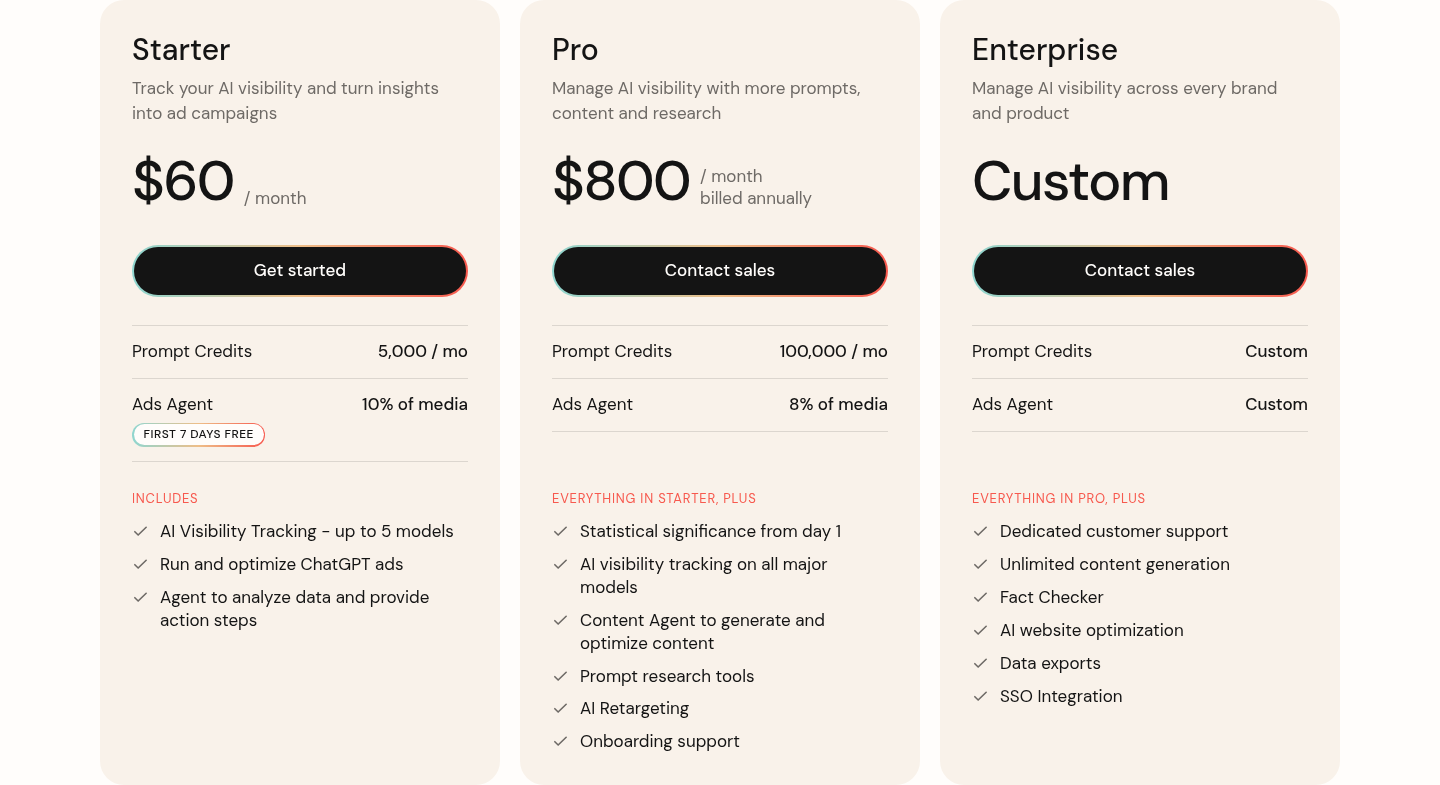
The feature to compare with Athena's content tools is Content Studio. It tests message variants around a brand attribute and develops an article from selected messages. It requires Pro, which includes 25 articles per month. Evaluate that workflow at the Pro price; it is not part of Starter's $60 offer.
Before switching, test the work you need to do
- Write down the recurring workload. List your questions, models, countries, and run frequency. Add any API, seat, and content-feature charges to the plan price.
- Use your own buying questions. Keep wording and settings consistent while comparing reports. Our prompt-selection guide helps you choose a useful starting set.
- Complete one investigation. Open an answer, inspect its sources, and identify a specific page or discussion worth working on. Judge how much useful work the tool saves you.
- Preserve the history you need. Export your Athena prompts and reports before cancelling. Check what the replacement can import; past answers may not transfer.
AthenaHQ alternatives FAQ
Is AthenaHQ free?
Essential provides 300 introductory credits, advertised as $25 in value. The public plan does not promise a recurring monthly free allowance. Starter is the published ongoing plan at $295/month with 3,600 monthly response credits.
Does unlimited prompt creation mean unlimited answers?
No. Athena charges one credit per AI response. Forty questions across three models once a day consume 3,600 credits in a 30-day month. Additional runs require more credits even if you do not add any questions.
Which AthenaHQ alternative is best for a small SaaS team?
We recommend Clare when you want to focus on commercially relevant buyer questions and investigate specific website and source opportunities. For a larger fixed daily prompt set shared by several people, compare Peec. OtterlyAI Lite is worth testing when 15 prompts are enough.
Can a cheaper tool replace Athena's content features?
Compare the exact task you need to complete. Clare provides opportunities and supporting evidence you can investigate yourself or with an AI assistant. Peec has shared Actions, while Otterly provides recommendations. Evertune's Content Studio requires a higher plan. Neither a low starting price nor a long feature list tells you how useful the workflow will be for your team.
Start your Clare trial with a few important buyer questions. Use the answers to find your next piece of work, and keep monitoring after you make the change.