Clare Videre is our pick among Profound alternatives for B2B SaaS teams that want to turn buyer questions into specific website and source work. You can track your own prompts, inspect the answers and competing brands, and investigate the evidence behind each suggested task. Peec AI is worth comparing for bundled tracking and team reporting; OtterlyAI has a smaller monthly entry plan.
The main reason to look beyond Profound is the buying experience. Its current brand offer pairs a limited trial with custom Enterprise pricing. This guide compares seven alternatives by what you can track, what you can investigate, what happens next, and what the published price actually includes.
Profound alternatives at a glance
| Tool | A good reason to choose it | Public plan and allowance |
|---|---|---|
| Clare Videre | Investigate SaaS buyer questions and act on the evidence | $99.95 monthly credit minimum; captured ChatGPT answers cost $0.10 each |
| Peec AI | Daily multi-engine tracking with unlimited users and shared Actions | Starter: €85/month, 50 prompts, three models |
| OtterlyAI | Start with a small prompt set and weekly recommendations | Lite: €29/month, 15 prompts, four engines |
| Rankscale | Control execution budgets and trace claims to their sources | Pro: €99/month, 1,200 credits; a smaller annual Essentials plan is also available |
| AthenaHQ | Combine tracking with content optimization | Starter: $295/month, 3,600 response credits |
| Scrunch | Audit and improve the pages AI systems encounter | Core: $250/month, 125 prompts, 5,000 monthly responses |
| Evertune | Research brand attributes and test content messaging | Starter: $60/month; Content Studio requires Pro at $800/month billed annually |
Prices retain the currencies shown in our linked pricing pages and screenshots. Prompt slots, response allowances, and credits measure different things; the workload example below shows how to compare them.
What changes when you leave Profound?
Start with the restriction that matters to your team. Profound's brand trial runs 50 recommended prompts daily for seven days across ChatGPT, Gemini, and Google AI Overviews. You cannot edit that trial prompt set, and the plan does not include history, exports, or API access.
Enterprise adds editable prompts, up to nine answer engines, historical data, exports, and API access under a custom agreement. For a small SaaS team, the practical reasons to compare alternatives are a published budget, a trial using its own buyer questions, and a workflow it can use immediately.

Profound already goes beyond measurement. Its AI Marketer suggests projects and tasks, and its Enterprise MCP integration connects external AI assistants. A useful alternative should make the work easier for your team, whether that means investigating one missed buyer question or coordinating a larger content program.
1. Clare Videre: our choice for hands-on B2B SaaS teams
Clare suits the founder or small marketing team that will investigate the answers and make the changes. Add your own questions or review suggestions from your website, organize them with tags, and choose daily or weekly tracking. You can concentrate your run budget on the questions that matter most.
Here is an actual example. For “best Reddit monitoring tool for B2B SaaS,” Clare showed Syften in all 37 recorded answers in the selected 30-day view, tied for the highest mention rate. The same screen lists competing products and the pages recorded with those answers.

The useful next step is visible in the report. Our Reddit monitoring tools guide appears alongside external comparisons. We can review those pages for outdated product descriptions, missing buying criteria, or pricing changes, then keep tracking the same question. The report provides a concrete starting point; it does not establish that a particular source caused the mentions.
For weaker questions, Clare produces tasks backed by observations: prompts missing your brand, source gaps, drops in mention rate, and relevant Reddit discussions. Open the supporting answers yourself or connect your AI assistant through Clare's MCP integration to investigate and propose changes. That is the workflow we recommend Clare for: a buyer question, inspectable evidence, and a justified next task.
You can explore a second example without signing up: our interactive ChatGPT sample report contains 50 answers about familiar collaboration products, with the prompt, mention counts, source URLs, and answer previews.
Clare pricing
The $99.95 monthly minimum becomes usage credits. Captured ChatGPT and Gemini answers cost $0.10 each; OpenRouter API runs add model costs and fees. One user is included, and each additional accepted member adds $20/month, also issued as credits. Monthly credits expire after three months and require an active subscription or trial.

Try Clare for seven days with $50 in credits. A card is required, with no charge during the trial. Start with the questions your next customer would ask.
2. Peec AI: bundled tracking and shared action workflows
Peec is a strong shortlist candidate when several people need a shared view of prompts, competitors, and work in progress. Starter bundles 50 prompts, three selected models, daily tracking, and unlimited users; our monthly pricing capture shows €85. You can enter your own prompts or upload a CSV.

Its source analysis helps identify pages that mention competitors while omitting your brand. Actions add supporting evidence, briefs, task states, completion dates, and an Impact view. Its MCP integration also connects external AI assistants. That makes Peec worth testing when assigning and following up on shared work is central to the purchase.
Compare it with Clare using the same investigation. Peec's bundled daily coverage can be economical for a large multi-engine workload; Clare lets you focus runs on selected questions and work through its website and Reddit opportunities. Our Peec AI alternatives guide goes deeper into that comparison.
3. OtterlyAI: a small monthly plan with recommendations
OtterlyAI Lite starts with 15 prompts tracked daily across ChatGPT, Google AI Overviews, Perplexity, and Microsoft Copilot. Our capture shows €29/month and unlimited users. Claude, Gemini, and Google AI Mode are paid add-ons.

Otterly also has AI recommendations with supporting reasoning. You can move them into a to-do list, add notes, and mark work on the performance chart. Lite includes three recommendations per week. Recommendations require at least 15 tracked prompts, three competitors, and three runs.
Choose Lite when 15 prompts cover your initial questions. If you need API or MCP access, budget for Standard; those features are not part of Lite's entry price.
4. Rankscale: flexible credits and detailed source tracing
Rankscale is worth testing when you want to control execution frequency and investigate what an answer says about a product. Its run detail exposes the answer, brand positions, citation URLs, and search fan-out queries. The sentiment workflow lets you investigate a negative attribute and inspect sources attached to the relevant statement when citation markers are available.

The pricing table includes unlimited prompt creation, but execution consumes credits. Pro has 1,200 monthly credits, ten brand dashboards, and 50 page audits. Pro+ adds REST API access; a smaller Essentials plan is billed annually.
The distinction matters when choosing engines: ChatGPT uses 0.25 credit per run, while Claude uses two. Compare the credit calculator with the engine mix you need, then test whether its Scout recommendations lead to useful work.
5. AthenaHQ: tracking with content optimization
AthenaHQ Starter costs $295/month with 3,600 monthly credits, unlimited topics and prompts, and coverage across 11 models. It combines source and competitor insights with a base content-optimization agent, integrations, and CSV export. API access and additional credits are paid add-ons.

One credit represents one AI response. Using Athena's credit calculation, 40 questions across three models once a day consume 3,600 credits in a 30-day month. Adding more models, locations, or repeat runs changes the budget.
Shortlist Athena when you want content optimization alongside monitoring. Check the feature table carefully: advanced content optimization, multiple regions, and its Recommendation Engine are Enterprise features.
6. Scrunch: page audits and AI crawler delivery
Scrunch is a useful comparison when the work starts with a page: can AI systems access it, understand it, and find information relevant to the buyer's question? Its optimization workflow connects citations and agent traffic with page audits and content improvements. Custom prompts can be organized by topics, personas, and geographies.
Core costs $250/month for 125 prompts and 5,000 monthly responses, with four AI platforms, five page audits, and five seats. It covers one country, one language, and one persona. Its Agent Experience Platform, available on Enterprise, can deliver an AI-optimized version of a page to crawlers while preserving the human-facing site.
Choose Scrunch when page diagnostics and delivery are the main requirement. If you want AXP, request the Enterprise terms rather than assuming the Core price includes it.
7. Evertune: brand research and message testing
Evertune's Starter plan costs $60/month for 5,000 monthly prompt credits and up to five models. You can edit its suggested topics and prompts, including whether the question names your brand.
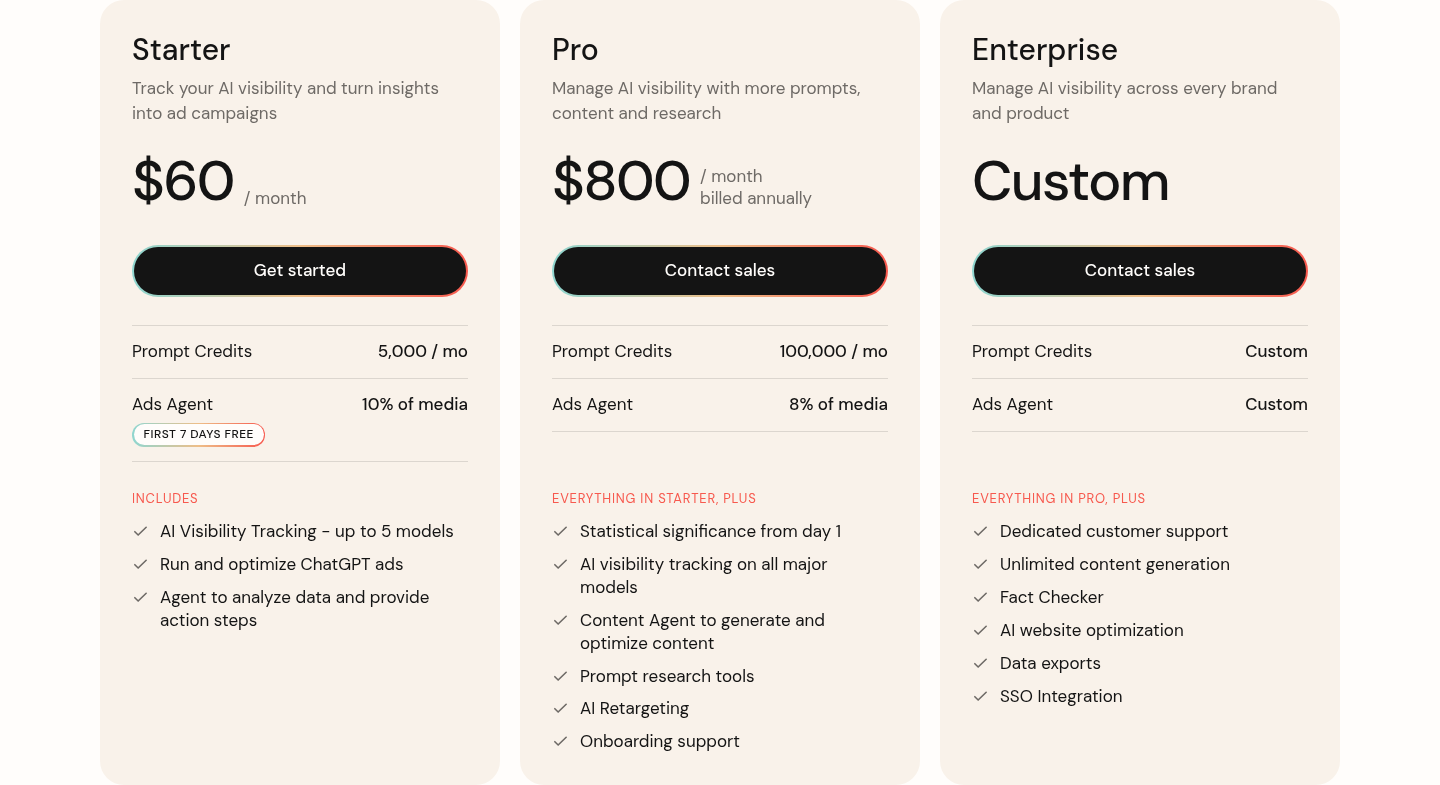
The larger distinction is Content Studio. It starts from a brand attribute, tests message variants, and develops an article from selected messages. This is a different workflow from investigating an individual missed buyer question.
Content Studio requires Pro, which includes 25 articles per month; Starter does not include it. Evaluate Evertune when message research and content production justify that package. Message testing alone does not establish that publishing the article improved visibility.
Compare the cost of the monitoring you will actually run
Start with questions × engines × runs per day × days. Then check what each vendor's unit buys. For example, 20 buyer questions run twice daily in ChatGPT produce 1,200 answers over 30 days.
| Pricing model | What to calculate |
|---|---|
| Clare's run credits | 1,200 captured ChatGPT answers consume $120 in credits. The $99.95 monthly payment funds that usage; additional credits cover the remainder. |
| Peec's bundled prompts and models | Starter's 50 daily prompts across three models correspond to 4,500 answers in a 30-day month. Check whether its fixed daily cadence fits your sampling plan. |
| Athena's response credits | One response uses one credit. Fifty questions across three models daily need 4,500 credits, exceeding Starter's 3,600 allowance. |
| Rankscale's execution credits | 1,200 ChatGPT runs use 300 credits at the listed rate. The same number of Claude runs uses 2,400 credits. |
These are capacity calculations, not promises that different capture methods produce identical answers. Include the seats, exports, regions, and integrations your team needs before choosing a plan.
How to evaluate a replacement with your own questions
- Choose a small commercial prompt set. Include a category question, an alternative question, and a use case your product handles well. Our prompt-selection guide gives examples.
- Inspect the evidence behind one result. Open the answers, compare the brands mentioned, and follow the recorded source URLs. Keep the prompt wording, engine, and market consistent when comparing tools.
- Leave with one useful task. Identify the page or discussion, the evidence supporting the work, and the specific change to investigate. Record what you ship and keep monitoring.
- Save your existing history. Export the reports and prompt text you need before cancelling. Check migration support rather than assuming historical answers will transfer.
For the SaaS team doing that work itself, start with Clare Videre. The trial should help you answer a concrete question about your market and identify a next step worth taking. Our AI visibility monitoring guide explains how to turn the counts and sources into that decision.
Profound alternatives FAQ
What is the best Profound alternative for a small SaaS team?
We recommend Clare for teams that want to investigate buyer questions, inspect source evidence, and work through specific opportunities. Peec is worth comparing for bundled multi-engine coverage and shared task tracking; OtterlyAI Lite suits a first set of 15 prompts.
Does Profound still have a $99 brand plan?
The brand pricing page checked on October 26, 2026 lists a free Trial and custom Enterprise pricing. A comparison based on the old Starter and Growth prices does not describe that current offer.
Can I use my own prompts in Profound's trial?
Profound's trial FAQ says its recommended prompts cannot be customized. Enterprise supports editable prompts. If testing your existing buyer questions is essential, agree on that evaluation before purchasing or try an alternative that lets you set them directly.
Will switching tools improve my AI rankings?
Switching changes how you measure and investigate visibility. The useful test is whether the new tool helps you find and complete better work. Track the same questions after making changes, and measure website visits and conversions separately from AI mentions.